
• Instagram
  • Official LINE account
  • KakaoTalk

Tattoo Removal

Tattoo removal

  1. Home
  2. Tattoo removal

Now taking bookings

Laser treatments start on
Thursday 9 October 2026.

Bookings are open now for dates from 9 October onwards. Please book online or through our official LINE account.

What we can help with

  • You are aiming for complete removal
  • You want to make a tattoo less noticeable first
  • You want to lighten a tattoo for a cover-up
  • You only want to remove a small tattoo
  • You were not satisfied with treatment elsewhere
  • You tried to remove it yourself and it did not work

FEATURES

About the treatment

What is PicoWay?

At our clinic we offer tattoo removal with the PicoWay laser, as well as surgical excision, in which the tattoo is cut out. Tattoos that could not be removed by laser may be suitable for excision, so please talk to us. PicoWay fires in picoseconds (trillionths of a second) — shorter than the nanoseconds (billionths of a second) of the conventional Q-switched lasers traditionally used for tattoo treatment. Because each pulse is so short, very little heat is produced, and the treatment raises peak power while keeping pain and damage to the skin to a minimum. With three wavelengths, it can also treat brightly coloured tattoos and blue or green ink. The device has undergone safety testing and is approved by Japan’s Ministry of Health, Labour and Welfare and by the U.S. Food and Drug Administration (FDA).
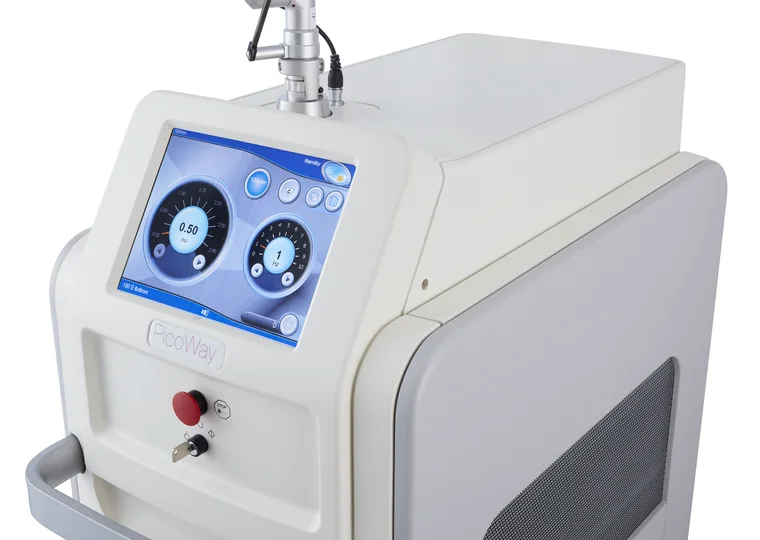
PicoWay laser

Three wavelengths, chosen for the colour of the tattoo

In tattoo removal, the wavelength that ink responds to best depends on its colour. At OKACHI CLINIC we use PicoWay’s three wavelengths — 532 nm, 730 nm and 1064 nm — according to the colour and condition of the tattoo. For tattoos with several colours, the doctor checks the colours and the condition of the skin and chooses a suitable wavelength for each. Response to the laser varies from person to person. Depending on the type, colour, depth and amount of ink, some pigment may remain even after several sessions.

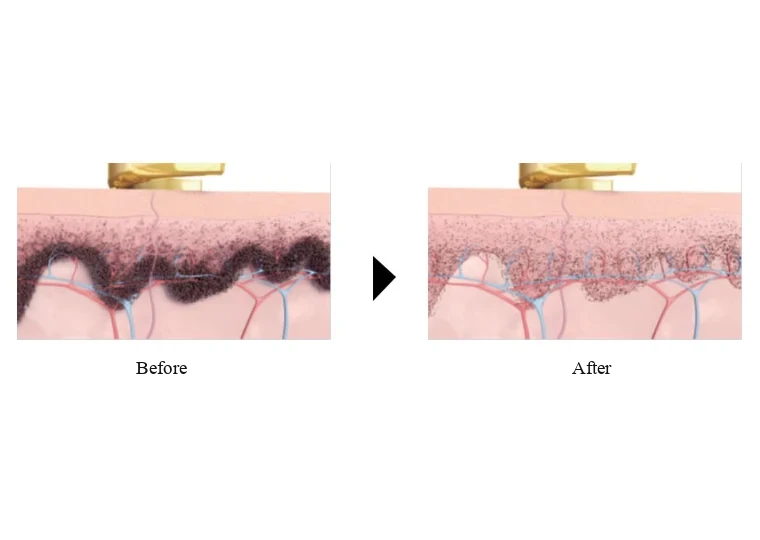
How the laser breaks up pigment

Choosing the wavelength

1064 nm | Black tattoos
Used for black ink. Suitable for a wide range of skin types (I–VI).
532 nm | Red, yellow, purple, blue, green, orange and more
Used for a variety of coloured inks other than black. The laser is applied while checking the colour of the tattoo and the condition of the skin.
730 nm | Light blue and light green
Used for inks such as light blue and light green. For colours that were difficult to remove in the past, the wavelength is also chosen according to the shade.

How easily each colour fades

Black / navy
Responds best. Absorbs 1064 nm well; the colour most common in traditional Japanese tattoos.
Red / orange
Responds relatively well. Treated with 532 nm. These colours are also more likely to cause allergic reactions.
Blue / purple
Responds relatively well. Treated with 730 nm. These colours were difficult for older devices.
Green
Somewhat difficult. Treated with 730 nm, but some pigments respond poorly.
Yellow / white
Most difficult. These reflect light and absorb little laser energy, so complete removal can be difficult.
Eyeliner and eyebrow tattoos
Needs care. The ink can turn dark through oxidation straight after treatment, so a cautious approach is needed.

About the device

Device
PicoWay, made by Syneron Candela
Type
Picosecond laser (picosecond KTP / Nd:YAG laser)
Pulse duration
The laser fires in picoseconds (trillionths of a second) — shorter than the nanoseconds (billionths of a second) of the conventional Q-switched lasers traditionally used for tattoo treatment. Because each pulse is so short, less heat is produced; the treatment aims to raise peak power while keeping pain and strain on the skin down.
Wavelengths
It has three wavelengths — 532 nm, 730 nm and 1064 nm — which are used according to the colour and depth of the pigment.
Approval
Japanese medical device approval number 23000BZX00270000. The device is approved in Japan and by the U.S. FDA for the treatment of deep and superficial pigmented lesions of the skin and for tattoo removal.

Treatment time and what to expect

  • Treatment timeAbout 5–30 minutes (depending on the area)
  • AnaesthesiaNumbing cream is included in the fee
  • On the dayThe treated area is covered with ointment, gauze and tape
  • Showering / bathingDepends on the condition of the treated area. We check your skin after treatment and advise you
  • ProgressThe area turns whitish straight after treatment, and redness, swelling or blisters may follow. Scabs form within 1–2 weeks and fall off naturally
  • Next sessionAbout 2 months later (to let the skin recover)

Aftercare

  • If blisters form, do not burst them — please contact the clinic
  • Do not pick off scabs, as this can cause scarring
  • Use sunscreen and protect the area from UV thoroughly
  • Do not pick off scabs
  • Do not rub the treated area hard
  • Avoid getting a suntan during the course of treatment
  • On the day of treatment, avoid strenuous exercise, saunas and alcohol

Who cannot receive this treatment

We cannot treat you if any of the following apply

  • You have a wound or skin tumour in the treatment area
  • You are pregnant or breastfeeding
  • You have an infection, inflammation, herpes or a skin condition in the treatment area
  • You tend to form keloids
  • You are sensitive to light, or are taking a medicine that increases sensitivity to light
  • You have epilepsy
  • You have gold threads in the treatment area
  • The treatment area is strongly suntanned or sunburnt

Depending on your health and any medicines you take, we may also ask you to postpone treatment for other reasons. The doctor decides whether the treatment is suitable for you at the consultation.

Side effects and risks

Redness, swelling, pain, blisters and scabs occur. These are a normal part of the treatment process, but loss of pigment (white patches), darkening of the skin, scarring (including keloids), whitening of hair and colour changes in the ink may remain. The ink may not disappear completely even after repeated sessions, and fees cannot be refunded in that case. The cost of treating any side effects is borne by the patient.

* This is private (self-funded) treatment, not covered by insurance. Results vary from person to person and are not guaranteed.
* If you notice any symptoms that concern you, please contact the clinic promptly.

FLOW

How a visit works

Arrival

Come in at your appointment time. Filling in the online medical form beforehand makes check-in quicker, and first-time visitors are always welcome.

01

Consultation

Your doctor asks what is bothering you and what you would like to change, then examines the area. You will hear what the treatment involves, what it can realistically do and what to watch for — and nothing goes ahead until you are comfortable.

02

Treatment

The treatment is carried out as agreed, adjusted to you rather than to a set formula. How long it takes depends on the procedure; either way, we keep it as easy on you as we can.

03

Going home

Before you leave, we go through how to look after the area over the next few days. If anything worries you afterwards, get in touch — at any point.

04

AFTERCARE

Aftercare

Looking after you afterward

Our care does not end when you leave the clinic. If you have a question or something does not feel right, call us or message our official LINE account and we will help. We would rather hear from you early than have you wonder.

PRICE

Fees

Tattoo removal (per session, tax included, numbing cream included)

AreaPrice
Mole-sized dot¥8,500
Up to ¥500-coin size (up to 5.5 cm²)¥11,500
Half a business card (5.5–25 cm²)¥16,900
1 business card (25–50 cm²)¥22,900
2 business cards (50–100 cm²)¥40,900
3 business cards (100–150 cm²)¥54,900
4 business cards (150–200 cm²)¥63,900
5 business cards (200–250 cm²)¥71,900
Large (6 business cards or more)¥11,500 per business card (50 cm²)
Lettering 1 × 5 cm¥11,500
Lettering 1 × 10 cm¥16,900

* All prices include tax.
* Colour tattoos are charged at the listed price plus 10%.
The area is calculated from the maximum height × width of the tattoo. If there are several tattoos, the total area is used.
Unusual colours, layered tattoos and very dense tattoos are quoted after the consultation.
As a guide, about 5–10 sessions are needed, roughly once every 2 months.

CASE

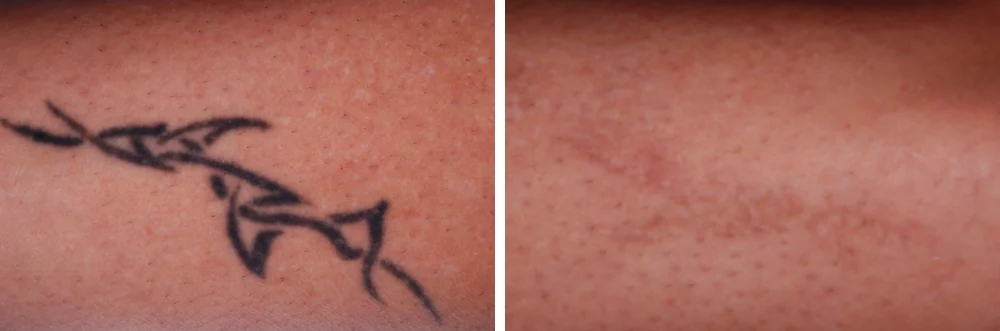
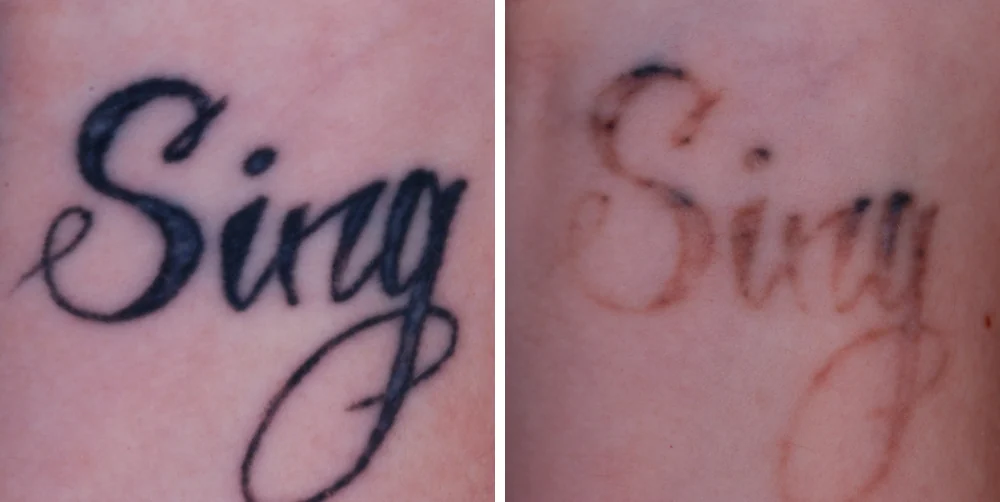
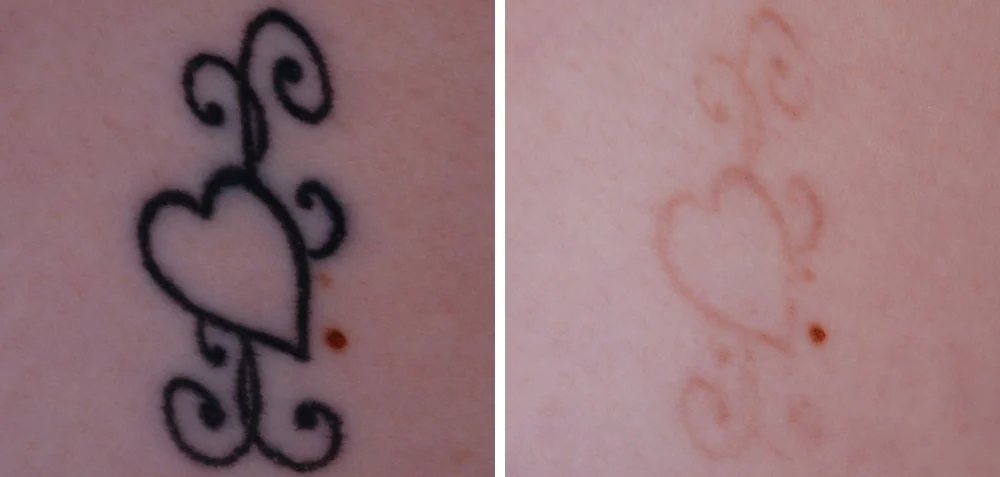
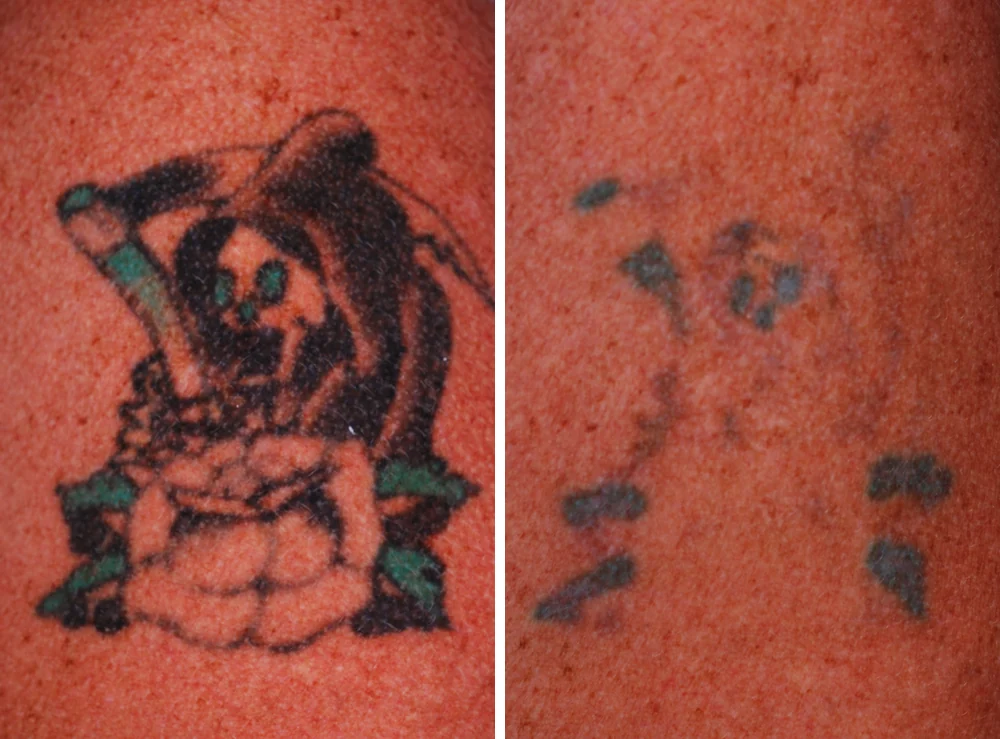
Before & after

Tattoo removal — before and after treatment
Before (left) / after (right)
Tattoo removal — before and after treatment
Before (left) / after (right)
Tattoo removal — before and after treatment
Before (left) / after (right)
Tattoo removal — before and after treatment
Before (left) / after (right)

* These are cases from other clinics, taken from materials provided by the manufacturer. They are not cases treated at our clinic.
* Results and the number of sessions needed vary from person to person, and we cannot promise similar results.
* This is private (self-funded) treatment, not covered by insurance. Please see “Fees” above for prices.
* The main risks and side effects are listed under “Side effects and risks”.

Reserve-Bookings & questions-